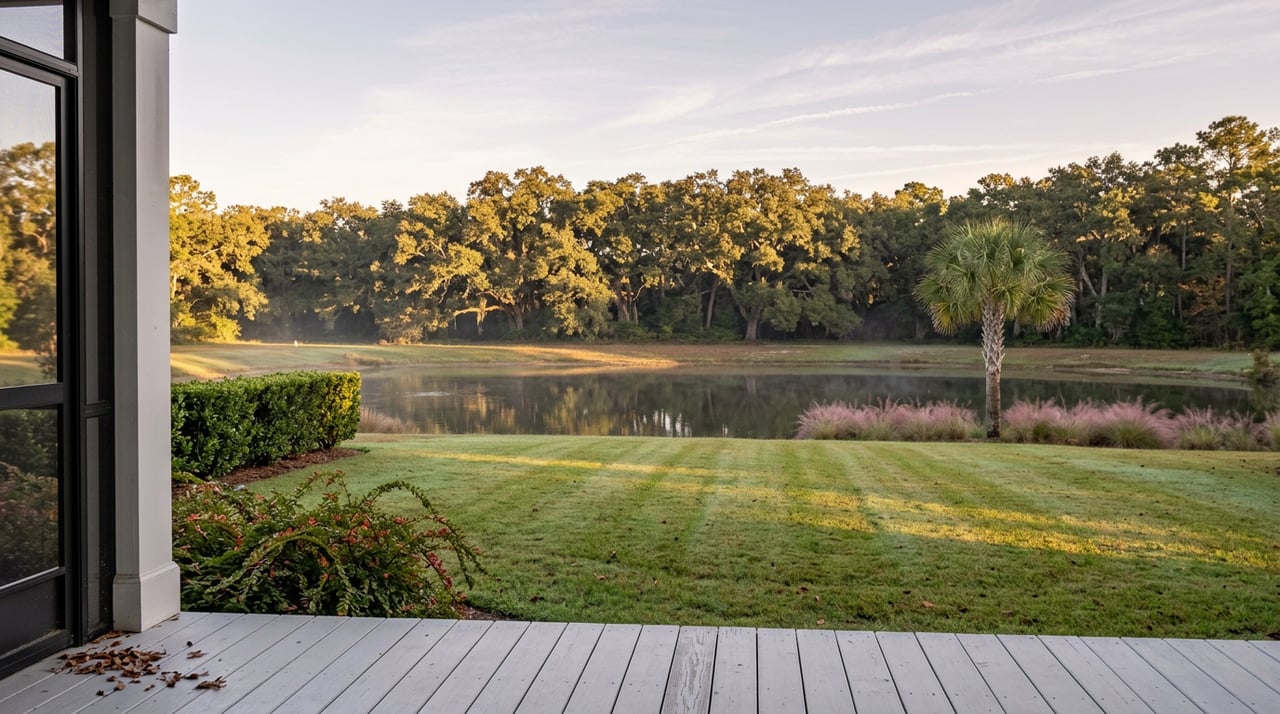
Sea Island Preserve Amenities on Johns Island: What's Finished
September 3, 2026
September 3, 2026
For most of the last four years, living inside the gate at Sea Island Preserve meant living next to a job site. Framing crews on one street, sod trucks on another, a model home with a sales trailer parked where a family's future side yard would eventually go. That's just what a new-build community looks like while it's still being built. What's different now, heading into fall 2026, is that it isn't anymore. The builder is sold out. The pool, the trails, the pickleball courts, the fire pit, all the things that used to show up in marketing copy with the word "planned" in front of them, are just there now, no qualifier needed.
That's a small distinction on paper. It's a real one if you've been driving past a half-finished pavilion for two years wondering when it would actually be usable.
Sea Island Preserve broke ground as one of Pulte's larger Johns Island projects, with the first completed homes closing in late 2022. Construction continued in waves through 2023, 2024, and 2025, which is a normal pace for a community with this many homesites carved out of 360-plus acres of oversized lots and preserved land. What's notable is where things stand now. Recent listings inside the community describe homes built as recently as 2025 as some of the final opportunities to buy new, with the builder now sold out of remaining inventory. That's a meaningful marker for anyone who's lived here through the build-out. It means the phase of the neighborhood defined by staging areas and construction traffic is over, not winding down, over.
Earlier marketing materials for Sea Island Preserve described the pool, the pickleball courts, and the picnic pavilion as planned amenities. Two pickleball courts were "planned." The resort-style pool with its splash pad was "planned." That forward-looking language was still showing up as recently as early 2025. Listings from this year tell a different story. Homes currently on the market describe residents enjoying a working pool with a splash pad and water feature, two finished pickleball courts, a putting green, an open-air pavilion, a community fire pit, fishing ponds, and miles of walking and biking trails that wind through more than 360 acres set aside for parks and conservation, which by Pulte's own account is more than half of the community's total footprint.
If you moved in during the early phase, you bought into a promise. If you're living here now, you're living inside the thing that was promised.
Here's the plain inventory, the kind you'd want if you were trying to figure out what's genuinely usable this week rather than what's coming eventually:
That list reads like standard new-community boilerplate until you remember it wasn't real for most of the people who've lived here. It is now. The trails in particular are worth noting because they're not a token loop around a retention pond. Half the community's acreage was set aside for parks and nature, and it shows in how much of the walk from one end of the neighborhood to the other passes through actual tree cover and marsh edge rather than side yards.
One honest gap worth flagging, since a resident review of the completed community pointed it out directly: there's no dedicated clubhouse for events. The pool area functions well as a gathering spot, but if you're looking for indoor event space for a birthday party or a club meeting, that's not part of what got built. Worth knowing before you assume it's coming.
Sea Island Preserve sits off Main Road, which puts it in an odd but increasingly useful position: far enough from downtown Charleston to feel removed, close enough to a cluster of Johns Island restaurants that the drive for dinner rarely tops ten minutes. Current listings inside the community consistently point to the same handful of names within about five miles: The Royal Tern, Wild Olive, Low Tide Brewery, The Tomato Shed, Kiss Cafe, and Estuary Beans & Barley. That's not a random list pulled from a Johns Island tourism page. It's the actual rotation residents here are working with for a weeknight dinner or a Saturday coffee run, and it's dense enough now that you're choosing between options rather than settling for whatever's closest.
For a weekend with nowhere in particular to be, the Angel Oak sits within easy reach, and Beachwalker Park on Kiawah Island, the public county beach access point, is roughly a 30 minute drive. Freshfields Village, with its mix of shops and restaurants, is close enough to fold into the same afternoon. Downtown Charleston runs about 30 to 35 minutes depending on the route and time of day, which puts Sea Island Preserve on the outer edge of what most people would call a convenient commute, but well within range for an occasional dinner or a museum trip that doesn't require planning the whole day around it.
None of this is new information if you've lived here a while. What's changed is the density. A few years ago this stretch of Maybank Highway and Main Road had scattered options. Now it has enough concentration that "what's for dinner" has a real answer most nights without leaving Johns Island.
The headline isn't that Sea Island Preserve got a new amenity. It's that the neighborhood stopped being two things at once, a finished section and a construction zone, and became one thing: a completed community with a working set of amenities and a maturing food and errand radius around it. If you bought early, based on renderings and a sales trailer, you're now living in the version of the place that was described to you, not an earlier draft of it. If you're newer to the neighborhood, everything you're using, the pool, the trails, the pickleball courts, was built to be used, not built to be finished eventually.
That distinction matters more than it sounds like it should. A lot of new-construction Lowcountry communities take years to close the gap between what's marketed and what's delivered. Sea Island Preserve has closed it. The dump trucks are gone. The pavilion has a fire pit next to it instead of a permit sign. And the five restaurants worth knowing are close enough that "close enough" stopped being a caveat.
If you're weighing a move to Johns Island, or you already live here and you're curious what a finished-community trajectory like this can mean for resale value and long-term demand, that's a conversation worth having with someone who tracks these shifts as they happen rather than after the fact. Anthony Barrasso has spent over 20 years working Johns Island and the broader Lowcountry market, and he's watched more than a few new communities make this exact transition from construction site to settled neighborhood. Let's Connect if you want a clear-eyed read on what that transition means for your property or your next one.
Stay up to date on the latest real estate trends.

Experience the confidence that comes from working with a seasoned Broker committed to protecting your goals and delivering exceptional results. Contact Anthony today to start your home searching journey!